The Church of Bones
Overview
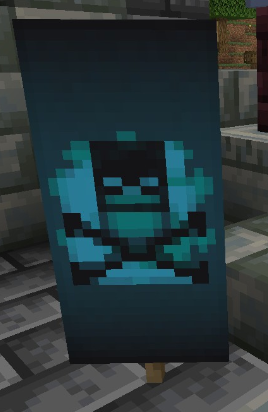
The Church of Bones is a decentralized religion organised by the council of bishops in worship of the God of Bones
A god of Living and Dying, neither Life nor Death, instead the existence between.
History
Evolution of the Chruch
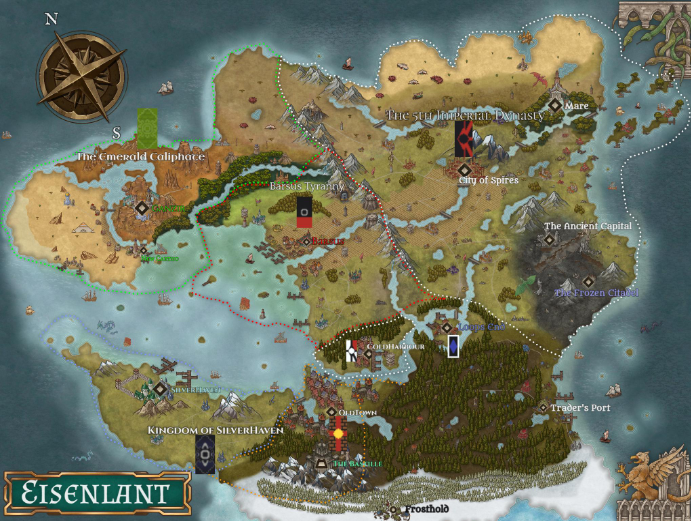
The History of the Church begins in a continent of Olera known as Eisenlant. In what is known as the Age of Ancients, a time period before the rise of the lands of various beast-like races as well as the common, it is said various clans of the common man lived amongst caves and tunnels surrounding a great city only known as the City beneath Stone. These clans and tribes scavenged and fed on scraps of these unknown ancients and worshipped various gods/spirits of life and death, much of this time is only recalled by legend as these are times when the common of Eisenlant were more or less in a stone age. In these legends a great Fire consumed the continent and burned away much of these Ancients as well scattering the various lesser races of the time. In the aftermath much of these clans and tribes migrated south into the frozen taiga looking for cooler climate.
Darrow's Council
In 1002 B.B.(before breaking) in the Age of the Bronze Star,these clans and tribes worked bronze and gold, while the beast-like races like that of BirdFolk and Skaven had kingdoms and the startings of their first empires, and common folks in distant corners of the continent began works on their first true cities. These clans, tight knit by intermarriage and interwar, would hear of Darrow, the First and Last Prophet, who is said to behold nightmarish visions and a skeletal figure far beneath, who called to him to worship. Darrow would in coming years force the various clans to a conclave in which he would through means unknown today force their chiefs and druids to behold his truths, that their gods and spirits were the Lord of Bones and that it was no god of life nor death but of living and dying. It was in his teachings the initial Cult of Bones was formed, and that in his death no singular shamen or druid could take sole leadership, instead colcaves would be held amongst them no matter how friendly or hostile the relationship between their clans were. This lasted for centuries as time passed and the rise and fall of empires.
The Forming of the Church
In the Age of Iron Gold Eisenlant was dominated by the Old Empire of the Birdfolk and its sprawling Ancient Capital, the only other major empire was that of the 3rd Dynasty ruled by common man ruling much of the taiga lands from their Frozen Citadel. Surrounded by minor kingdoms and tribes these two empires had a tenuous peace for while the Birdfolks empire was the greater and older, the 3rd dynasty was quickly growing and easily defended, so conflict was through espionage and politics between these giants. The clans in this dynamic existed within the 3rd Dynasty at first a regional cult, until the year 516 B.B. when the Ruler at this time in an effort to gain prestige and find a rival to the Feathered Pantheon would rapidly promote the cult and thereby the clans as well through their society. This would create strife and a notable massacre of some clans that refused to fall in line. This process would civilize the cult away from its practices of blood sacrifice and ritual, and would force the clans to adapt to more civilized ways. As most societies of the times people were very stratified, and so the clans would be made to a priest class as well as officers and some generals in the legions, druids and shamans made bishops and priests. This would form the Church of Bones, and solidify the rulers of the 3rd Dynasty position amongst religion in politics.
The Great Breaking
its exact cause unknown, some blame the hubris and richness of the two empires, many blamed bird or man but in its cause mattered little only the devastation it wrought. A great Wither rose from the earth between the empire's capitals ripping apart the land, and in its wake armies of wither skeletons and lesser withers followed, all they killed rose undead and beneath its command. The armies of Bird and Man rose to meet them for it was not just a battle to save their cities nor their empires but all life on Eisenlant. In the days of the great breaking the clans were decimated and the ruler of the 3rd dynasty dead, the bishops of the church dead or missing. In the Paladin and officer of the legion Damien would rally the forces of man enlisting every person who could walk and hold a weapon be the grown or child. The King of the Birdfolks empire Voraelix would summon all to fight and would fill the skies with his followers. This war for however short was one of untold heroes and tragedies, magi burned to ashes pushing their magic to their limit, knights in last stand, and untold hordes of people who held simple spears or tools to name fighting the forces of entropy. In the aftermath Voraelix and the Highfeather Clans would pursue the beaten enemy into the Nether, and in the great corpse of the wither Paladin Damien would find horror and sorcery to find undeath, reforming the church once more beneath old tenets and new creeds and becoming the first bishop of a new council who would take the ritual of undeath. The Church would in its dwindled number spread far and wide from those tainted wastes and create a system to make worship to the God of Bones more diverse to rebuild their fallen number.
Much of the history of the Church post breaking would be that of proselytizing and politics. Until the year 704 A.B.(after breaking) when the 5th Dynasty would be crowned ending 197 years of war within Eisenlants heartlands. The council of bishops would be approached with an opportunity for them to crown this conqueror an emperor and bind the Church once more and in turn become the official religion of the Empire. After deliberation and a vote they agreed and was once more bound, and for a time would bring a golden age for the Church, but as centuries pass the empire grew with corruption and bureaucracy that its size could not maintain with civil war and eventually a branch family's seizing of the throne.
Recent History
In modern day the empire is a puppet, truly balkanized between countless dukes and counts, and many of the benefits the Church held are more or less gone. But in recent years in the wake of a fresh civil war the Church would officially divorce itself from the throne. At this time rising powers such as Silverhaven and Barsus would carve pieces of the continent for themselves and would pursue new technologies of black powder and magic. Barsus of note would beginning sea voyages that would result in their discovery of Molendia, and in their wake some priests and monks of the church would follow though in this land the dominance of the Theocracy would prove to limit the spread of faith, but on a distant mountain priests would witness the rise of High Roost, a resurrection of the Highfeather clans to the world and would at haste travel back to Eisenlant to inform the bishops. The council upon this news would deliberate and vote, and in turn Archbishop Damien would abandon their old holding and strike a deal with the High Theocrat of Barsus would travel to Molendia. Upon the mountain those priests witnessed HighRoost rise the Archbishop would declare a new holy site and in the year 1226 A.B. begin the mining of the mountain and the eventual building of a new grand cathedral.
Church Hierarchy
The Church is organized in tiers as follows:
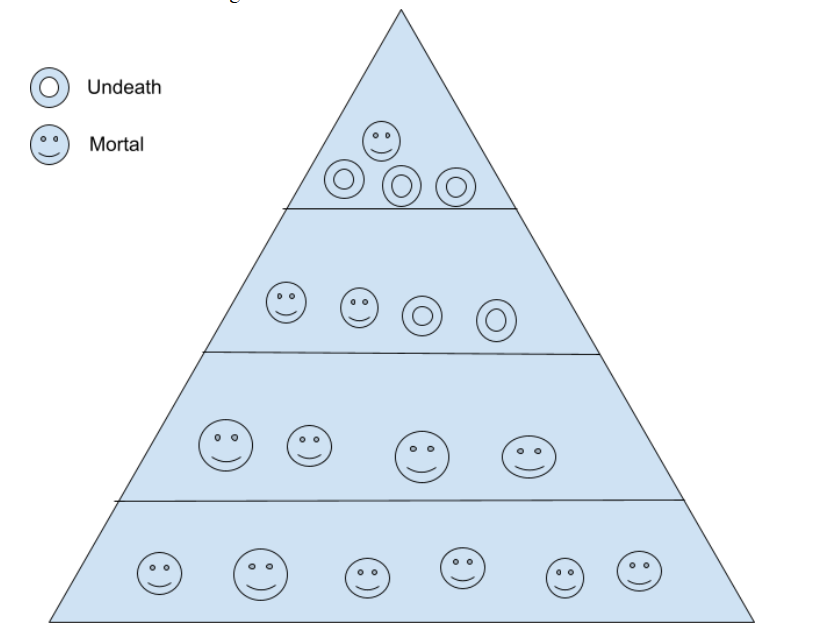
The lowest tier is that of the faithful, just everyday people who worship the god of bones. The second up is that of local priests or priests in service to other priests. The Third up is those of High Priests operating out of greater churches and Priests who hold titles such as paladin or fork bearer,. Finally the uppermost tier is the Bishops and Archbishops who sit equal to each other on council with no sole individual acting as leader. Most overall decisions of the church must go through the council and must pass a majority vote.
Main Tenents of the Church
The 3 main tenents of the church are as follows;
The worship in Living and Death
Because this can be taken in a many different ways there is no definite rules to what exactly it is or how one worships, only that it ties to the theme of Living and Dying and what is life and death but not being life nor death. They must however worship the living and dying not life nor death, whether they interpret that in a physical, mental, spiritual, philosophical form.
There is no sole voice or ruler to the Church
The Church does not speak as one for itself and its followers , rather that it is headed by a council of Bishops all with equal say and power No individual can claim to speak for our God.
That Undeath or Undead are revered in some manner
Recognised by the Church as the sole Existence truly neither in life nor death bt eternally between.
In all other Manners one's belief in the Church is up to the individual, whether it be what form of undead they hold in reverence or what manner Living and Dying is whether physical or philosophical.
Undeath
Undeath, a gift and martyrdom, it is the pinnacle of that in-between, the living and dying made eternal. Its ritual was pioneered in the years just post the Great Breaking. The original ritual over the centuries has been modified by different creeds to produce different results, but to focus on the original, true undeath is shrouded in mystery only known to a select few. The process of elevation is only for the few honoured or for bishops to undertake, the ritual is committed within secret by specialized soul magic most of which is kept secret, and afterward for the individual's death. The newly Undeath would appear most untouched except for wounds as the body would no longer heal, as rotting will not set in for a decade. After which time has passed, rotting begins to set in, liquid and gas must be drained and often personal braziers burning incense are carried to cover the smell. It is during the process of rotting that senses begin to fade, touch, taste, hearing, often magic runes would be carved into bone using soul magic to simulate some of these senses. After 30 or so years flesh begins to fall off and often it is at this time those of Undeath would remove their flesh entirely, runes to articulate bones and to simulate sight, as well speak are carved, and the individual is finally in their final form.
Individuals of undeath that be wights, draugrs, or true undeath are effectively immortal finding stronger resistance to injury and no effect of time physically. The passage of time does affect those of undeath mentally however, many after a few centuries begin developing tendencies for obsession or memory issues, some become husks devoid of humanity and others outright madness. Of course those of mental fortitude may last longer but the mortal mind is not made for eternity and sooner or later symptoms do develop, and if coping mechanisms are not developed by individuals and their mental state devolves to a feral state Church executioners are to show them mercy.
Joining the Priesthood
The Church accepts any and all, to become a priest only requires a person ask there local Bishop, and in time and service a priest can become a Bishop along with running their own cathedral as well
Creeds
Creeds are a form of worship to the God of Bones, following the three main tenets, while allowing an extreme amount of freedom in how they worship or what they exactly believe. This system has always existed since Darrow's days, but only after the Breaking was it expanded upon in an effort to gain as many followers as possible
Blood Creed of the Church
The Blood Creed is a belief in the Church of Bones that war is the highest form of Living and Dying. That in the midst of the battlefield an individual can truly experience faith in the God of Bones.
1st Tenet of the Blood Creed
That in war and conquest true Living and Dying is seen and experienced, and its warriors who adhere to this and fear nothing shall be rewarded with endless enemies and spoils.
2nd Tenet of the Blood Creed
That its officers and generals confer in action of the battlefield. Some true of the faith and paladins often act alone, and create strife in command, but duel and diplomacy may end this.
3rd Tenet of the Blood Creed
That reverence for Draugr, either those made in undeath or naturally occurring, undead warriors fed on violence and vengeance in an endless cycle.
This creed is often found in warrior priests and paladins of the church. The creed holds to monotheism and a disregard for other faiths — not outright hostile, but nowhere near kind — with some zealots who call to crusade. Their main and only form of diplomacy they hold to is violence, mostly through direct means, with only a few taking positions as priests within churches.
This is a creed of the church whose faithful see the Lord of Bones as a God of War, who embrace violence and conflict as true faith — that warriors and action of battle is prayer.
The Plebeians Creed
A creed held widespread through most of the common folk of Einselant, a creed that reinforces the lowly serfs place in the world and their duty to thier Lord and Church.
1st Tenet of the Plebeians Creed
The Plebeians Creed holds the faith that living and dying is in the action of the common persons duty. Whether in the farmers field, the smithy, or in war with simple spear in hand. Working their place in life.
2nd Tenet of the Plebeians Creed
That while no one ruler holds thier faith, that they must hold to thier lords command, for they have a divine right empowered by the Chruch to rule over them.
3rd Tenet of the Plebeians Creed
Thier faith in those of undeath are in those of the high priests and bishops of the church who are of faith, that while very very few of their strata may ever be so blessed, that those above them are in undeath.
This creed sometimes known as the commons creed, is used to maintain the feudal system within the kingdoms of Eisenlant.
They maintain a polytheistic belief with local gods and deities often acting as minor gods depending on region, with the Lord above all.
Priests of this creed are many, but of low position within the church mainly in charge of remote or village churches. With no real power they are forced to do with what little they have for diplomacy, and are often used by those higher in the Church.
Followered by the many commoners, often tool to keep them in line, but often as well helps to give Hope and Meaning in their daily life in this creed.
Church Relations
The Church’s relationship to nations of Molendia are mostly neutral or nonexistent, with some exceptions mostly HighRoost due to its shared past and Barsus due to its business relationship.
HighRoost and the Church hold a odd relationship for while the Pantheon of Birds and the God of Bones are neutral to each other, the followers bird and man do blame each other for the Great Breaking and Inquisition from the Church in the early years after the breaking pursued many Birdfolk, and while the centuries have cooled such hatred, some do call back to old xenophobia. But their shared past in fighting the breaking and their shared enemy in the withers do draw them together, in the end part way allies and enemies.
Barsus while supporters of the Church hold no official religion and their relationship is more so business than true loyalty to each other, Barus giving resources and transport, while the Church gives advisorship as well as manpower through their faithful. Whether that remains depends on the future for even in the recent war with HighRoost and the Sultanate where the Church and Barsus were on different sides, neither held true animosity. Both walked away paid and when Barsus opened a treaty port in the Sultanate a new Church to the God of Bones was created.
The Theocracy, the largest religion of Molendia and one of the richest nations is an old bulwark that has stemmed much of the Church's spread of faith. While the Church officially holds neutrality to them, much of its upper priesthood holds the Machine Goddess and her followers in contempt, and while some creeds of the church may hold a favorable view, the Old Creed that holds majority in the new Bishops council is anti machine, believing them soulless automation of an evil goddess.
The Church and its future are uncertain at this time, as new ventures in a new land and a drive to extend its faith draw itself slowly into new conflicts and its leadership is rebuilt from new stock.But whether for good or evil the Church will grow, new creeds to be established, new churches to be constructed, and an ancient God to worship.
{(✿◡‿◡)}